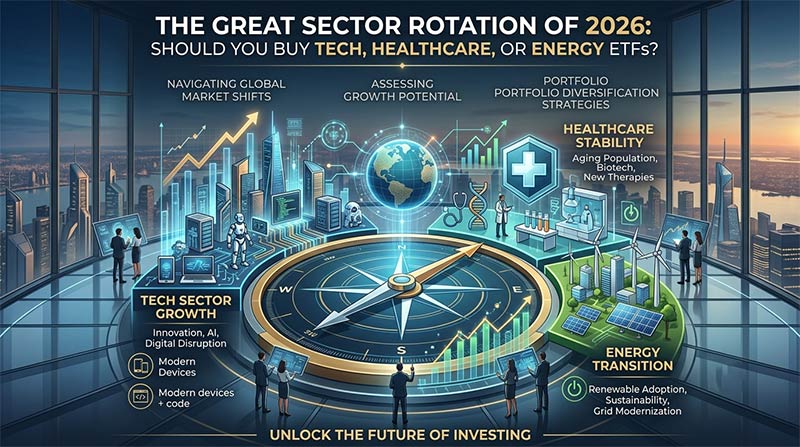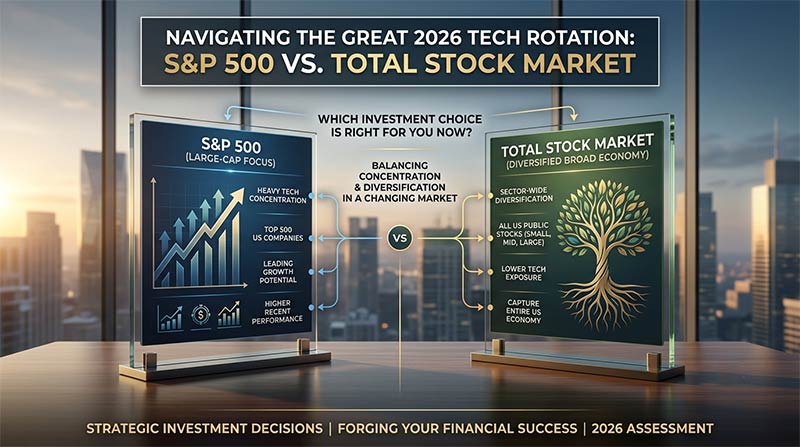
For years, the gold standard of passive investing could be summed up in three words: “VOO and chill.” Parking your cash in an S&P 500 index fund and letting megacap tech do the heavy lifting was a foolproof strategy. But as we cross into the second half of 2026, the structural plumbing of the U.S. equity market has fundamentally shifted, forcing long-term investors to rethink their baseline exposure.
With inflation hitting a three-year high of 4.2% and the Federal Reserve—under new Chair Kevin Warsh—reigniting rate hike anxieties, volatility has returned with a vengeance. More importantly, market concentration has reached a historical breaking point. The ten largest companies now command nearly 40% of the S&P 500, and semiconductor stocks alone make up roughly one-fifth of the entire index.
If you are choosing where to route your next paycheck, the choice between an S&P 500 fund (like VOO or IVV) and a Total Stock Market fund (like VTI) isn’t just academic anymore. It’s a structural bet on whether you want a highly concentrated tech portfolio or a broader safety net.
Beneath the Surface of the 2026 Volatility
To understand why this choice matters today, look no further than the chaotic market action of June. The quarter closed out with spectacular gains, driven in part by Elon Musk’s SpaceX pulling off a historic $75 billion IPO that briefly pushed its valuation toward $3 trillion.
But immediately after, a massive undercurrent took hold: The Great Rotation.
Investors began questioning the near-term returns on Big Tech’s massive AI infrastructure spend. Profits were shaved off chip makers and hyperscalers and rotated heavily into unloved, defensive sectors and small-cap stocks. Look at how that divergence played out in the mid-year fund performance:
- S&P 500 Index Funds (VOO): Slipped 0.95% in June as megacap tech took a breather.
- Total Stock Market Funds (VTI): Fell just 0.33%, heavily insulated by its inclusion of mid- and small-cap companies (tracked via indexes like the Russell 2000, which surged to record highs during the same period).
When the top ten names carry the entire index, an S&P 500 fund ceases to be a diversified cross-section of the American economy. It becomes an aggressive, momentum-driven tech vehicle.
Face-to-Face: S&P 500 vs. Total Market
While both funds share a 0.03% rock-bottom expense ratio and overlap by more than 80% in total dollar weight, their structural risk profiles have decoupled in 2026.
| Feature / Metric (Mid-2026 Data) | S&P 500 Index Fund (e.g., VOO) | Total Stock Market Fund (e.g., VTI) |
| Number of Holdings | ~505 | ~3,484 |
| Top 10 Holdings Concentration | ~40% (Near historical highs) | ~32% |
| Semiconductor Sector Weight | ~20% | ~16% |
| Small & Mid-Cap Exposure | 0% | ~15% to 20% |
| 2026 YTD Return (as of July) | ~10.19% | ~9.85% |
| Primary Risk Factor | High vulnerability to AI/Tech corrections | Drag from underperforming small-caps during tight credit |
Data Sources: Vanguard VOO Product Profile & Vanguard VTI Product Profile.
The Analytical Perspective: Where Should You Allocate?
The YTD metrics show the S&P 500 still holding a slight edge due to the explosive first-quarter tech run. However, blindly chasing that premium right now ignores the shifting macro landscape.
If you believe the domestic economy is resilient enough to handle Kevin Warsh’s hawkish Fed, small- and mid-cap companies have immense valuation catch-up to do. They haven’t enjoyed the massive multiple expansion that tech infrastructure has enjoyed over the past three years.
Choose the S&P 500 if:
You view the current AI buildout not as a temporary bubble, but as a structural earnings revolution. Despite software providers like Intuit plunging 60% in the first half of the year, the structural hardware bid remains fierce. If you want maximum exposure to the ultimate winners of global scale and corporate buybacks, stick to the large-cap titans.
Choose the Total Stock Market if:
You are uncomfortable with 40% of your “passive” portfolio resting on the shoulders of just ten management teams. A Total Market fund gives you an automated hedge. When tech cools off—as it did in June—the index naturally captures the upside of cyclical rotations into industrials, financials, and small-caps without requiring you to time the market.
In a highly concentrated, volatile 2026 environment, true diversification requires moving down the market-cap ladder. For new capital, leaning into a Total Stock Market fund provides the necessary breathing room to survive the inevitable valuation corrections of the megacaps, while still leaving your foot firmly on the tech accelerator.

Want to Make Money From Home ?
Join 55,000+ real, remote ways to make money every week.
Good luck! I hope you find the perfect remote opportunity for your lifestyle and goals.