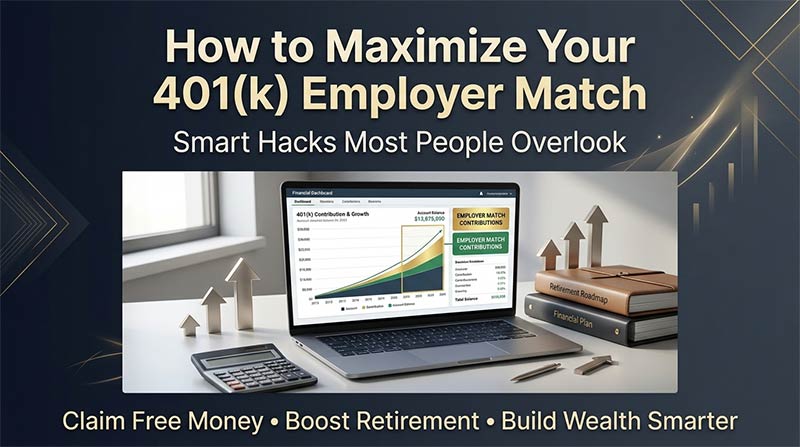
If someone handed you an envelope containing $3,000 in crisp hundred-dollar bills every single year without asking for anything in return except that you save a portion of your own paycheck, you would grab it without hesitation.
Yet, millions of working professionals do the exact equivalent of leaving that envelope on the breakroom table.
Employer matching contributions represent one of the purest forms of “free money” in modern personal finance. It is an immediate, risk-free 50% to 100% return on your invested dollars before those funds ever touch a stock or bond index. Despite this obvious benefit, industry data indicates that American workers leave tens of billions of dollars in unclaimed 401(k) employer matches on the table every year.
Why does this happen? In my experience reviewing corporate retirement plans and advising employees, it is rarely due to apathy. Instead, it stems from a fundamental misunderstanding of the fine print inside employer retirement plans. Most people assume that simply setting their contribution rate to “5%” or “6%” guarantees they are extracting every possible dollar from their company’s match. Unfortunately, payroll mechanics, front-loading traps, confusing vesting schedules, and shifting tax regulations frequently siphon away thousands of dollars in matching funds behind the scenes.
As we navigate 2026, capturing every matching dollar requires a updated blueprint. The Internal Revenue Service (IRS) has raised the baseline 401(k) employee elective deferral limit to $24,500, with standard catch-up contributions rising to $8,000 for those aged 50 and older, and a specialized “super catch-up” limit of $11,250 for workers aged 60 through 63. Coupled with new SECURE 2.0 provisions regarding Roth catch-ups and employer Roth matching options, the rules of the game have evolved.
Whether you are aiming to fine-tune your retirement strategy, avoid costly front-loading mistakes, or coordinate high-income bonuses, this guide covers the actionable 401(k) matching maximization hacks that most employees overlook.
Hack 1: Deciphering the True Matching Formula & Vesting Schedule
The first step in securing full 401(k) matching is understanding the exact mathematical formula your employer uses. Companies rarely write a blank check; instead, they structure matching contributions around two distinct variables: the match percentage and the salary cap.
[Your Contribution Rate] × [Match Percentage] (Up to Salary Cap) = Employer Match
Deconstructing Common Matching Formulas
Not all 6% matches are created equal. Consider these three common formulas:
- 100% Match up to 4% of Salary: Your employer matches dollar-for-dollar on every dollar you contribute, up to 4% of your total eligible compensation. If you earn $100,000 and contribute $4,000 (4%), your employer contributes $4,000. Total saved: $8,000.
- 50% Match up to 6% of Salary: Your employer matches 50 cents on the dollar for every dollar you contribute, capped at 6% of your salary. If you earn $100,000 and contribute 6% ($6,000), your employer contributes $3,000 (3% of your salary). Total saved: $9,000.
- Tiered Match (e.g., 100% on the first 3%, 50% on the next 2%): Here, contributing 5% of your salary yields a total match of 4% (3% + 1%).
Expert Insight: Notice the difference between option 1 and option 2. To capture the full match under a “50% up to 6%” structure, you cannot stop at 3%. If you only contribute 3%, you only receive a 1.5% match! You must put in the full 6% out of your pocket to trigger the full 3% employer match.
The Hidden Trap: Vesting Schedules
Getting the match deposited into your 401(k) account is only half the battle; owning it is the other. Your employer’s vesting schedule determines how much of those matching funds you get to keep if you leave the company.
- Immediate Vesting: You own 100% of the employer match from day one.
- Cliff Vesting: You own 0% of the matching contributions until you reach a specific service milestone (e.g., 3 years), at which point you instantly jump to 100% vested.
- Graded Vesting: You gain ownership of matching funds in gradual increments over time (e.g., 20% after year two, 40% after year three, reaching 100% after year six).
Real-World Example: Imagine Sarah receives $5,000 a year in employer matching under a 3-year cliff vesting schedule. If she resigns at 2 years and 11 months to take a new job, she forfeits $15,000 in accumulated matching funds. Waiting just four more weeks would have preserved that entire sum. Always cross-reference your employment anniversary date with your plan’s vesting schedule before submitting a resignation letter.
Hack 2: Pacing Contributions & Triggering the “True-Up” Provision
One of the most devastating financial blunders high earners and aggressive savers make is front-loading 401(k) contributions without verifying whether their plan features a true-up provision.
The Front-Loading Trap Explained
Employers typically calculate and deposit matching contributions per pay period. If your company matches contributions on a pay-period-by-pay-period basis, you must be actively contributing during that specific pay period to receive the match.
If you max out your annual elective deferral limit early in the year, your payroll software automatically halts your 401(k) deductions for the remaining pay periods. Consequently, you contribute 0% during those final months—and your employer contributes 0% in matching funds.
Case Study: The $12,000 Front-Loading Mistake
Let’s look at Mark, who earns $240,000 per year ($10,000 per semi-monthly pay period across 24 pay periods). His employer offers a 5% dollar-for-dollar match per pay period (up to $500 per pay period, or $12,000 annually).
- Strategy A (Front-Loading): Eager to max out his 2026 limit of $24,500 quickly, Mark sets his contribution rate to 30% ($3,000 per pay period).
- By Pay Period 9 (early May), Mark reaches the $24,500 contribution cap.
- For Pay Periods 1 through 8, he received the full $500 match ($4,000 total). For Pay Period 9, he contributes the remaining $500 to hit $24,500, receiving a $500 match.
- For Pay Periods 10 through 24, Mark’s contribution is forced down to $0.
- Result: Mark receives only $4,500 in employer matching out of the potential $12,000 cap. He loses $7,500 in free money!
- Strategy B (Paced Contributions): Mark divides $24,500 evenly across all 24 pay periods (~$1,020.83 per pay period, or ~10.21%).
- He contributes every single pay period.
- His employer matches $500 every single pay period.
- Result: Mark collects the full $12,000 employer match.
The Solution: The “True-Up” Provision
To protect employees from this exact scenario, some progressive employers include a True-Up Provision in their plan design. At the end of the calendar year (or early in the following Q1), the plan recalculates your annual contributions against your total annual salary. If you maxed out your plan early, the employer makes a single lump-sum deposit to “true up” your matching match to what you would have received had you paced your contributions.
Action Item: Call your 401(k) plan administrator or review your Summary Plan Description (SPD). Search for the words “True-Up.” If your plan does not offer a true-up provision, you must calculate your pay-period contribution percentage carefully to spread your contributions evenly across all pay periods through late December.
Hack 3: Strategic Use of Roth vs. Traditional 401(k) Options
Historically, all employer matching contributions were legally required to be placed into a pre-tax (Traditional) 401(k) account, regardless of whether the employee contributed to a Traditional or Roth 401(k).
However, thanks to provisions enacted under the SECURE 2.0 Act, employers are now permitted to offer vested Roth matching contributions.
Standard Matching (Traditional):
Contributions -> Pre-Tax | Growth -> Tax-Deferred | Withdrawals -> Taxed as Ordinary Income

SECURE 2.0 Match (Roth):
Contributions -> Taxed Currently | Growth -> Tax-Free | Withdrawals -> 100% Tax-Free in Retirement
How Employer Roth Matching Works in 2026
If your employer has updated their plan to support Roth matching, you can elect to have your employer matching funds deposited directly into your Roth 401(k) bucket.
- The Catch: Employer Roth matches are treated as taxable income to you in the year they are made. Your employer will include the matching amount on your Form W-2 as taxable compensation.
- The Benefit: That money grows entirely tax-free, and qualified withdrawals in retirement—including all accumulated investment gains—will be 100% federal and state income tax-free.
Should You Elect Employer Roth Matches?
Electing Roth matching is a powerful strategy if:
- You are early in your career or currently in a lower tax bracket relative to where you expect to be in retirement.
- You want maximum tax diversification in retirement to manage your future tax liabilities flexibly alongside traditional pre-tax balances.
- You have sufficient liquidity outside your 401(k) to pay the additional tax liability generated by the Roth match during tax season.
If you are a peak-earning professional in the 32%, 35%, or 37% federal income tax bracket, taking the traditional pre-tax match (or keeping your contributions pre-tax) often remains the superior mathematical move to reduce current taxable income. Explore our deeper dive into tax strategies to evaluate how Roth vs. Traditional balances impact your lifetime tax footprint.
Hack 4: Navigating the 2026 SECURE 2.0 Catch-Up Rules
For workers aged 50 and older, catch-up contributions provide an accelerated path to bolster retirement readiness. However, 2026 marks a major transition period with two critical developments that directly affect how high earners and older workers maximize their matching strategies.
1. The “Super Catch-Up” Tier (Ages 60–63)
Under the SECURE 2.0 framework, the IRS has established a tiered catch-up structure:
- Standard Catch-Up (Ages 50–59 and 64+): $8,000 for 2026. (Total employee limit: $24,500 + $8,000 = $32,500).
- “Super Catch-Up” (Ages 60, 61, 62, and 63): $11,250 for 2026. (Total employee limit: $24,500 + $11,250 = $35,750).
If you fall into the 60–63 age bracket, this enhanced limit allows you to pour substantial extra capital into tax-advantaged accounts. According to guidance published by the Internal Revenue Service (IRS), these higher caps adjust periodically for inflation.
2. Mandatory Roth Catch-Up Rule for High Earners
Starting in 2026, a major policy shift takes effect: If your FICA wages from your employer in the previous calendar year (2025) exceeded $150,000, all 401(k) catch-up contributions MUST be made into a Roth account. You are no longer allowed to make pre-tax catch-up contributions if you cross this income threshold.
Strategic Implications for High Earners:
- Cash Flow Adjustment: Because your catch-up contributions ($8,000 or $11,250) will now be made with after-tax dollars, your net take-home pay will decrease compared to previous years when catch-ups were pre-tax.
- Match Preservation: Verify that your plan sponsor permits catch-up contributions to qualify for matching (if you haven’t already hit the employer match ceiling through your base $24,500 deferral). In most plans, employer matching applies to the first dollars contributed, but ensuring your payroll system smoothly transitions your standard contributions into Roth catch-ups guarantees zero disruption in match processing.
Hack 5: Coordinating Bonuses, Merit Increases, and Side Income
Many professionals view their base salary as the sole driver of their 401(k) contributions. However, variable compensation—such as annual performance bonuses, commissions, and side-hustle revenue—presents both hidden risks and massive opportunities for capturing employer matches.
Base Salary Deferral: 6% ($6,000) -> Matched by Employer
Bonus Check ($20,000): 0% Deferral (Default) -> $0 Match
Correct Strategy: Set Separate Bonus Deferral Election -> Capture Full Bonus Match
Capturing Matches on Annual Bonuses
A frequent flaw in payroll setups is that default 401(k) contribution elections often do not apply to annual bonus checks unless you explicitly configure them.
If your company offers a 5% match on all compensation (salary plus bonus), and you receive a $30,000 annual bonus, failing to elect a deferral on that bonus check means forfeiting a potential $1,500 employer match in a single pay period.
- Step 1: Inquire with payroll 30 days before bonus distribution whether bonus deferrals require a separate election portal.
- Step 2: If your plan lacks a true-up provision, calculate how a large bonus deferral affects your overall pacing so you do not accidentally cap out your $24,500 limit too early in the year.
The “Auto-Escalation” Raise Pairing Hack
When you receive a salary increase (e.g., a 4% raise), immediately allocate at least half of that increase (2%) toward your 401(k) contribution rate.
By tying contribution increases directly to salary raises, you accomplish two goals:
- You completely avoid “lifestyle creep.”
- You automatically ensure you are contributing deep enough into your salary to absorb the full employer match percentage, even if the employer modifies or expands their matching tiers down the road.
Managing Side Income with a Solo 401(k)
If you consult or run a side business alongside your W-2 day job, you can open a Solo 401(k) for your business income.
- The Rule: The IRS $24,500 elective deferral limit (plus catch-ups) applies per person, across all individual 401(k) plans. You cannot contribute $24,500 at your corporate job and another $24,500 in elective deferrals to your Solo 401(k).
- The Hack: Max out your employee elective deferral ($24,500) at your primary W-2 employer to capture 100% of the corporate employer match. Then, as the “employer” of your side business, you can make employer non-elective contributions (up to 20% or 25% of net self-employment earnings) into your Solo 401(k). The employer side of your Solo 401(k) is governed by the total annual additions limit ($72,000 for 2026), giving you a dual-engine path to compound wealth rapidly.
To learn more about structuring self-employed retirement vehicles, review our actionable insights on broader retirement planning strategies.
Hack 6: Unlocking Advanced Capital Growth: The Mega Backdoor Roth
For high-income earners who have already maxed out their $24,500 employee contribution and captured their full employer match, there is an advanced strategy that expands tax-advantaged savings: The Mega Backdoor Roth.
While this strategy is primarily designed for high-capacity saving, it interacts directly with your employer match through the IRS Section 415(c) total annual additions cap.
Understanding the 2026 Limits
For 2026, the IRS limits total combined additions to a single 401(k) plan to $72,000 (or $80,000 / $83,250 with catch-up contributions).
Total Limit ($72,000) = [Employee Deferral ($24,500)] + [Employer Match] + [Voluntary After-Tax Contributions]
How the Mega Backdoor Roth Operates
If your corporate plan permits Voluntary After-Tax contributions (which are distinct from Roth 401(k) contributions) AND supports either in-plan Roth conversions or in-service distributions to a Roth IRA:
- Step 1: Contribute your initial $24,500 as pre-tax or Roth to capture the maximum employer match.
- Step 2: Allow your employer to deposit their matching contribution (e.g., $10,000).
- Step 3: Calculate your remaining space under the $72,000 cap:$$\$72,000 – \$24,500 – \$10,000 = \$37,500$$
- Step 4: Contribute up to $37,500 in Voluntary After-Tax dollars.
- Step 5: Immediately convert those after-tax dollars into a Roth 401(k) or roll them out to a Roth IRA.
This mechanism allows eligible plan participants to shelter up to $72,000 annually in tax-favored vehicles. To review institutional rules on after-tax roll-overs, consult educational resources from leading custodians such as Fidelity Investments or Vanguard.
Hack 7: Pitfalls That Silently Destroy Your Employer Match
Even well-intentioned investors lose significant funds by falling into operational traps. Here are three critical pitfalls to avoid:
1. The Mid-Year Contribution Pause
If money gets tight due to short-term expenses, your instinct might be to reduce your 401(k) contribution to 0% for a few months.
Doing so halts your employer match completely for those pay periods. Instead of dropping to 0%, lower your contribution to the exact minimum threshold required to preserve the full match (e.g., dropping from 15% down to 5%). That way, you maintain your 100% immediate return on that 5% slice while freeing up cash flow elsewhere.
2. Unintended 401(k) Loan Defaults
Taking a loan from your 401(k) might seem harmless, but payroll systems often handle loan repayments alongside contributions. If repaying a loan squeezes your paycheck to the point where you lower your elective deferral below the matching tier, you suffer a double blow: paying interest to yourself with after-tax dollars while losing out on uncaptured employer matching funds.
3. Missing the Vesting Date by Days
As noted in Hack 1, changing jobs right before a vesting anniversary is a common mistake. Always review your plan’s benefit portal to confirm your credited service hours. Many plans require 1,000 hours worked in a calendar year to gain a year of vested service. Leaving in November vs. waiting until January could mean the difference between keeping or losing thousands of dollars in employer matching balances.
Comprehensive 401(k) Matching Strategy Comparison
To help you decide which strategies align best with your situation, the table below compares key matching hacks across execution complexity, tax implications, and financial impact:
| Strategy / Hack | Target Audience | Key Requirement / Rule | Primary Benefit | Potential Risk / Trap |
| Paced Pay-Period Deferrals | All W-2 Employees | Divide $24,500 evenly across pay periods | Ensures 100% match capture if plan lacks a true-up | Front-loading early can forfeit matches in later months |
| True-Up Verification | Early Savers & High Earners | Confirm “True-Up” clause in Summary Plan Description | Allows front-loading without forfeiting employer matches | Assuming you have a true-up when your plan does not offer one |
| SECURE 2.0 Roth Match | Lower Tax Brackets & Young Savers | Employer plan must offer Roth match option | Tax-free growth & tax-free income in retirement | Triggers current-year taxable income on the matched amount |
| Super Catch-Up (60–63) | Employees Aged 60 to 63 | $11,250 catch-up limit for 2026 | Accelerates pre-retirement wealth accumulation | Must use Roth catch-up if prior-year FICA wages exceed $150k |
| Bonus Match Capture | Commission & Bonus Earners | Separate bonus election portal in payroll system | Prevents losing matches on large single-paycheck bonuses | Hitting annual limit too early if bonus is distributed in Q1 |
| Solo 401(k) Dual Engine | W-2 Workers with Side Income | Own a separate sole proprietorship/LLC | Unlocks employer-side profit-sharing up to $72k total | Employee deferral limit ($24.5k) is shared across both plans |
| Mega Backdoor Roth | High Income & High Savings Rate | Plan must allow voluntary after-tax & conversions | Shelters up to $72,000 annually in Roth accounts | Non-qualifying plans will result in ordinary income taxes |
Next Steps
Maximizing your 401(k) employer match is not a passive task. It requires actively auditing your plan’s mechanics, setting precise payroll instructions, and adjusting your contributions as tax rules and income levels shift.
To ensure you are not leaving free money behind in 2026, take these four steps today:
- Download Your Summary Plan Description (SPD): Log into your corporate benefits portal and search for three key items: Matching Formula, Vesting Schedule, and True-Up Provision.
- Audit Your Pay Stub: Verify your current contribution percentage against your base salary and annual bonuses. Ensure your contribution rate spreads your $24,500 limit across the full year if your plan lacks a true-up provision.
- Adjust for SECURE 2.0 Changes: If you are age 50+ and earned over $150,000 in 2025 FICA wages, prepare your cash flow for mandatory Roth catch-up contributions. If you are aged 60–63, evaluate taking advantage of the $11,250 super catch-up limit.
- Optimize Your Portfolio: Once your employer match is secured, ensure those funds are invested in low-cost index funds or targeted allocation models aligned with your risk tolerance.
By taking control of these details, you turn an ordinary 401(k) into an optimized, wealth-building tool.
For more guides on building long-term financial independence, smart asset allocation, and tax reduction strategies, explore our latest insights at www.cashing.top and read our detailed breakdowns on investing strategies.

Want to Make Money From Home ?
Join 55,000+ real, remote ways to make money every week.
Good luck! I hope you find the perfect remote opportunity for your lifestyle and goals.
Disclaimer: This article is intended solely for educational and informational purposes and does not constitute personalized financial, legal, or investment advice. Always consult with a qualified financial advisor or non-profit credit counselor regarding your specific situation.