When building a secure financial foundation, choosing the right retirement vehicle is one of the most critical decisions you will make. While putting money aside is a huge step in the right direction, where you hold those investments determines how much of your wealth you actually keep when it comes time to retire.
Individual Retirement Accounts (IRAs) remain among the most powerful wealth-building tools available to investors. However, deciding between a Roth IRA vs Traditional IRA often creates confusion—especially with IRS contribution limits and income phase-outs adjusting annually for inflation.
For 2026, the IRS has officially increased the annual IRA contribution limit to $7,500 for individuals under age 50, and $8,600 for those age 50 and older. Understanding the core differences between a Roth vs Traditional IRA in 2026 is crucial because picking the wrong account can cost you tens of thousands of dollars in unnecessary taxes over your lifetime.
In this comprehensive guide, we will break down:
- The fundamentals, tax mechanics, and rules for both Traditional and Roth IRAs.
- The official IRS 2026 contribution limits, catch-up rules, and updated income phase-out ranges.
- A clear side-by-side comparison matrix highlighting key account differences.
- A practical framework to determine which account is better for your personal financial situation.
- Advanced strategies like the Backdoor Roth IRA and Roth conversions to maximize your long-term returns.
- Critical tax mistakes to avoid.
What Is a Traditional IRA?
A Traditional IRA is a tax-advantaged individual retirement account that allows your investments to grow on a tax-deferred basis.
The defining characteristic of a Traditional IRA is its upfront tax benefit. When you contribute money to a Traditional IRA, you may be eligible to deduct that contribution from your current taxable income. For example, if you earn $80,000 a year and make a $7,500 deductible contribution to a Traditional IRA, your taxable income for the year drops to $72,500.
Taxable Income = Gross Income - Traditional IRA Contribution
               = $80,000 - $7,500
               = $72,500
Tax Treatment
- Contributions: Potentially tax-deductible in the year they are made, depending on your income and whether you (or your spouse) are covered by an employer retirement plan.
- Investment Growth: Tax-deferred. You do not pay capital gains or dividend taxes annually as your investments grow inside the account.
- Withdrawals: Distributions in retirement are taxed as ordinary income at your future tax bracket.
Core Rules & Eligibility
Anyone with earned income (such as wages, salaries, or self-employment income) can open and contribute to a Traditional IRA regardless of how much money they make. However, your ability to deduct those contributions on your tax return depends on your Modified Adjusted Gross Income (MAGI) and whether you participate in an employer-sponsored retirement plan like a 401(k).
- Age Limit: There is no maximum age limit for making contributions, provided you have earned income.
- Required Minimum Distributions (RMDs): Under current federal tax laws, you must begin taking RMDs from a Traditional IRA once you reach age 73 (which transitions to age 75 for individuals turning 74 in 2033 or later under SECURE 2.0).
- Early Withdrawals: Withdrawing earnings or pre-tax contributions before age 59½ generally incurs a 10% IRS penalty in addition to ordinary income taxes, unless a specific IRS exception applies (e.g., $10,000 lifetime limit for a first-time home purchase, qualified higher education expenses, or major unreimbursed medical expenses).
Practical Insight: Traditional IRAs excel when you are currently in a high tax bracket and expect to drop into a lower tax bracket during retirement. The upfront tax savings today provide immediate cash flow relief.
What Is a Roth IRA?
A Roth IRA flips the tax equation of the Traditional IRA. Named after Senator William Roth, this account is funded with after-tax dollars, meaning you get no tax deduction in the year you make a contribution.
In exchange for giving up the immediate tax break, the IRS grants you two enormous benefits: 100% tax-free growth and 100% tax-free withdrawals in retirement.
After-Tax Contribution ➔ Tax-Free Growth ➔ 100% Tax-Free Retirement Distributions
Tax Treatment
- Contributions: Made with post-tax dollars (no current-year tax deduction).
- Investment Growth: Completely tax-free.
- Withdrawals: Qualified distributions taken after age 59½ (and meeting the 5-year rule) are completely tax-free and do not increase your taxable income in retirement.
Core Rules & Eligibility
Unlike a Traditional IRA, the IRS places strict income eligibility limits on who can contribute directly to a Roth IRA. If your Modified Adjusted Gross Income (MAGI) exceeds certain IRS thresholds, your ability to contribute is reduced or phased out completely.
- No RMDs During Owner’s Lifetime: Unlike Traditional IRAs, original owners of Roth IRAs are never forced to take minimum distributions. Your investments can stay in the account and compound tax-free for as long as you live, making the Roth IRA an extraordinary tool for estate planning and wealth transfer.
- Flexible Access to Principal: Because you have already paid taxes on your original contributions, you can withdraw your contributions (not earnings) at any time, at any age, for any reason, completely penalty-free and tax-free.
- The 5-Year Rule: To withdraw investment earnings tax-free and penalty-free, the Roth IRA account must have been open for at least five tax years, and you must be at least 59½ years old (or meet a qualifying exception).
2026 Contribution Limits, Income Phase-Outs & Rules
Understanding Roth vs Traditional IRA contribution limits 2026 is vital to ensure you take full advantage of tax laws while avoiding tax penalties for overcontributing.
The IRS adjusts IRA contribution limits and phase-out ranges periodically for inflation. Below are the official numbers for the 2026 tax year as announced in IRS Notice guidance.
1. Overall Annual Contribution Limits (2026)
- Under Age 50: $7,500 (up from $7,000 in 2025).
- Age 50 and Older: $8,600 (includes a $1,100 catch-up contribution).
Note: This overall limit is a combined total across all your personal IRAs (Traditional and Roth). You cannot contribute $7,500 to a Traditional IRA and another $7,500 to a Roth IRA in the same tax year.
2. Roth IRA 2026 Income Phase-Out Limits
If you want to contribute directly to a Roth IRA, your Modified Adjusted Gross Income (MAGI) must fall below the following thresholds established by the IRS:
| Tax Filing Status | Full Contribution Allowed (MAGI) | Partial Contribution Allowed (Phase-Out Range) | No Direct Contribution Allowed |
| Single / Head of Household | Under $153,000 | $153,000 – $168,000 | $168,000 or higher |
| Married Filing Jointly | Under $242,000 | $242,000 – $252,000 | $252,000 or higher |
| Married Filing Separately (lived with spouse) | N/A | $0 – $10,000 | $10,000 or higher |
Source: Official IRS cost-of-living adjustments, also confirmed via Vanguard’s IRA Educational Resource and Fidelity’s IRA Insights.
3. Traditional IRA 2026 Tax Deduction Phase-Out Limits
Anyone with earned income can make a contribution to a Traditional IRA, but your tax deduction phases out if you (or your spouse) are covered by a retirement plan at work (such as a 401(k) or 403(b)).
Scenario A: You ARE Covered by a Workplace Retirement Plan
If you participate in an employer-sponsored retirement plan, your Traditional IRA deduction phases out based on your MAGI:
| Tax Filing Status | Full Tax Deduction | Partial Tax Deduction | No Tax Deduction |
| Single / Head of Household | $81,000 or less | $81,000 – $91,000 | $91,000 or more |
| Married Filing Jointly | $129,000 or less | $129,000 – $149,000 | $149,000 or more |
| Married Filing Separately | N/A | $0 – $10,000 | $10,000 or more |
Scenario B: You ARE NOT Covered, but Your Spouse IS Covered
If you do not have a workplace retirement plan but your spouse does, the IRS offers higher income threshold phase-outs for married couples filing jointly:
- Full Deduction: MAGI of $242,000 or less.
- Partial Deduction: MAGI between $242,000 and $252,000.
- No Deduction: MAGI of $252,000 or higher.
Scenario C: NEITHER You Nor Your Spouse Are Covered by a Workplace Plan
If neither spouse is covered by an employer plan, you can claim a full tax deduction for your Traditional IRA contribution regardless of how high your income is.
Side-by-Side Comparison: Key Differences Explained
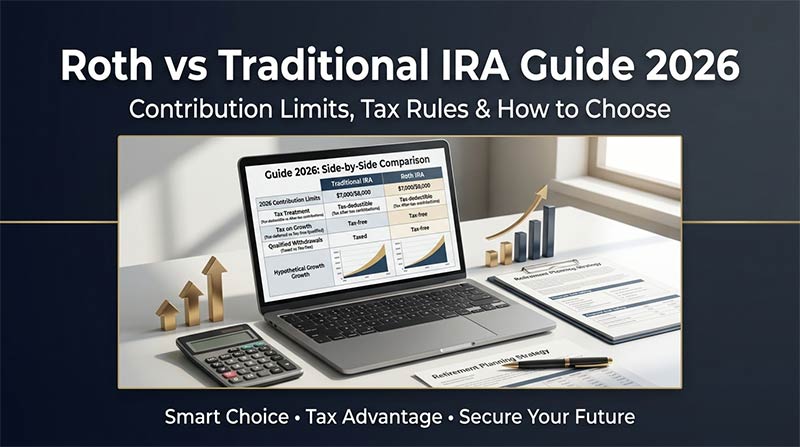
To help you visualize how these two accounts compare, here is a detailed side-by-side breakdown of Roth vs Traditional IRA rules, tax treatments, and features.
| Feature / Metric | Traditional IRA | Roth IRA |
| Primary Tax Benefit | Immediate upfront tax deduction | Tax-free earnings and withdrawals in retirement |
| Tax Rate Advantage | Best if current tax rate > retirement rate | Best if current tax rate < retirement rate |
| 2026 Contribution Limit | $7,500 (<50) / $8,600 (50+) | $7,500 (<50) / $8,600 (50+) |
| Income Eligibility to Contribute | No income limit to open/contribute | MAGI limits apply ($153k single / $242k joint) |
| Tax Deduction Eligibility | Subject to MAGI phase-outs if in workplace plan | No tax deduction available |
| Taxation on Growth | Tax-deferred until distribution | 100% Tax-free forever |
| Required Minimum Distributions (RMDs) | Mandatory starting at age 73 / 75 | None during owner’s lifetime |
| Withdrawal of Principal (Contributions) | Subject to tax + 10% early withdrawal penalty | 100% Tax-free & penalty-free anytime |
| Withdrawal of Earnings | Taxed as ordinary income (+ 10% penalty if <59½) | Tax-free if age 59½+ and 5-year rule met |
| Estate & Legacy Planning | Beneficiaries pay income tax on distributions | Beneficiaries inherit account tax-free |
Which Is Better: Roth or Traditional IRA in 2026?
A common question among investors is: which is better Roth or Traditional IRA 2026?
The mathematical answer comes down to a simple comparison: Your marginal tax rate today versus your effective tax rate in retirement.
If Current Tax Rate > Future Tax Rate  ➔  Traditional IRA Wins
If Current Tax Rate < Future Tax Rate  ➔  Roth IRA Wins
If Current Tax Rate = Future Tax Rate  ➔  Mathematical Tie
Because predicting future tax rates 20, 30, or 40 years from now is tricky, let’s examine practical scenarios where each account excels.
       +-------------------------------------------------------+
       |   How to Choose Your Primary IRA Account in 2026      |
       +-------------------------------------------------------+
                                   |
         Is your current income / tax bracket relatively low?
                                   |
                   +---------------+---------------+
                   |                               |
                  YES                             NO
                   |                               |
                   v                               v
        [ Choose Roth IRA ]            Are you covered by a 401(k)
        • Tax-free growth              at work & earning high income?
        • Tax-free withdrawals                     |
        • No RMDs in life          +---------------+---------------+
                                   |                               |
                                  YES                             NO
                                   |                               |
                                   v                               v
                        [ Backdoor Roth IRA ]           [ Traditional IRA ]
                        • Income too high for           • Claim full current
                          direct Roth IRA                 tax deduction
                        • Convert non-deductible        • Lower taxable
                          contributions                   income today
You Should Choose a Roth IRA If:
- You are early in your career or currently in a lower tax bracket: If you are currently in the 10% or 12% federal income tax bracket, paying taxes now is remarkably cheap. Locking in tax-free growth for decades is a massive financial victory.
- You expect tax rates in the U.S. to rise historically: Given national debt levels and long-term entitlement commitments, many investors believe future federal tax brackets will be higher than today’s historically low rates.
- You value liquidity and emergency flexibility: Since direct contributions to a Roth IRA can be pulled out at any time without taxes or penalties, the account doubles as a secondary backstop for emergency reserves.
- You want to avoid Required Minimum Distributions (RMDs): If you do not plan on needing all your retirement savings to cover living expenses, a Roth IRA lets your money compound untouched for your entire life.
- You earn below the 2026 MAGI phase-out thresholds: If your MAGI is under $153,000 (single) or $242,000 (married filing jointly), you can fund a Roth IRA cleanly and directly.
You Should Choose a Traditional IRA If:
- You are in your peak earning years: If your household income places you in the 24%, 32%, 35%, or 37% marginal tax brackets, saving 24 cents to 37 cents on every dollar contributed today provides immense financial savings.
- You qualify for the full tax deduction: If you are single and make under $81,000, or married making under $129,000 (with a workplace plan), taking the guaranteed tax break today is highly effective.
- You plan to retire in a lower-cost state or lower tax bracket: If you plan to move from a high-tax state (like California or New York) to a state with no income tax (like Florida, Texas, or Nevada) in retirement, deducting contributions now and paying lower state taxes later is a lucrative arbitrage strategy.
- You need to lower your current Adjusted Gross Income (AGI): Reducing your AGI can help you qualify for other income-sensitive tax credits, student loan repayment terms, or child tax benefits.
Strategic Wealth Tactics: Maximizing Your Benefits
Rather than viewing the decision strictly as an “either/or” choice, financial advisors frequently utilize advanced tax-efficient strategies to get the best of both worlds.
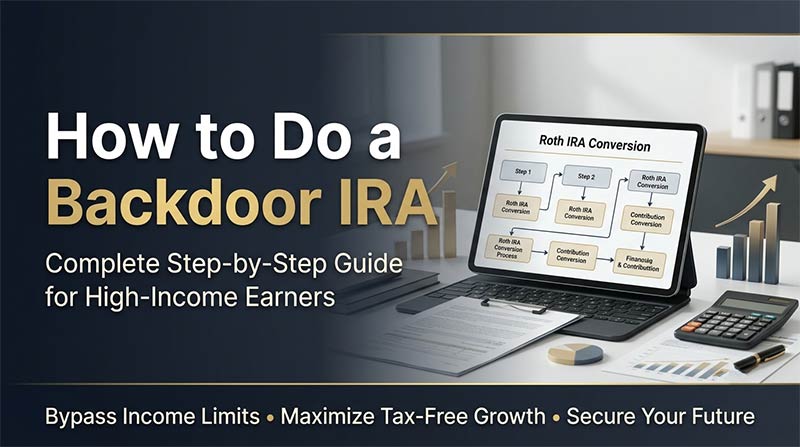
1. The Backdoor Roth IRA Strategy
What if your income exceeds the 2026 Roth IRA limits ($168,000 for singles or $252,000 for joint filers)? You can still fund a Roth IRA legally through a process known as the Backdoor Roth IRA.
Here is how the two-step process works:
- Make a non-deductible contribution to a Traditional IRA up to the $7,500 limit ($8,600 if age 50+). (There are no income limits on non-deductible Traditional IRA contributions).
- Shortly after the funds settle, execute a Roth conversion inside your brokerage account to transfer the money into your Roth IRA.
Crucial Warning (The Pro-Rata Rule): If you already hold pre-tax money in any Traditional IRA, SEP-IRA, or SIMPLE IRA, the IRS aggregates all your IRA balances when calculating taxes on a conversion (IRS Form 8606). Converting funds under these conditions can trigger an unexpected tax bill. To avoid this, consider rolling existing pre-tax IRAs into an active employer 401(k) before performing a Backdoor Roth conversion.
2. Tax Diversification (Holding Both Accounts)
Having all your retirement money in a single bucket limits your options later in life. Having tax diversification—a mix of pre-tax accounts (Traditional IRA, 401(k)), tax-free accounts (Roth IRA, HSA), and taxable brokerage accounts—gives you total control over your tax bill in retirement.
For example, in a year where you need extra income to buy an RV or renovate your home, taking extra withdrawals from a Traditional IRA might push you into a higher tax bracket or increase your Medicare premiums (IRMAA penalties). With tax diversification, you can draw down your Traditional IRA up to the top of your low tax bracket, and pull the remaining cash tax-free from your Roth IRA!
To learn how to coordinate your workplace retirement plans alongside individual accounts, read our guide on 401(k) investment strategies.
3. The Spousal IRA
If one spouse stays at home or does not have earned income in 2026, they can still open and fully fund their own Traditional or Roth IRA using the working spouse’s income.
Under a Spousal IRA, a married couple filing jointly can contribute up to $15,000 combined across two accounts ($17,200 if both are 50 or older), provided the working spouse’s earned income covers the total amount.
Common Mistakes to Avoid
Even seasoned investors make costly mistakes when navigating IRA regulations. Keep these hazards on your radar:
1. Overcontributing Due to Income Limits
If your MAGI unexpectedly exceeds the Roth IRA phase-out range during the year and you made direct contributions, you have an excess contribution. The IRS imposes a 6% excise tax penalty every single year that the excess remains in the account.
Solution: Contact your brokerage immediately before the tax filing deadline to execute a recharacterization or withdraw the excess contribution along with net income earned.
2. Leaving Contributions in Cash
Opening an IRA and depositing money is only step one. An IRA is merely a tax-sheltered basket—it is not an investment by itself. Millions of investors deposit money into an account only to realize years later that their money sat in an uninvested cash settlement fund earning negligible interest.
Once your cash lands in the IRA, actively purchase low-cost broad-market index funds, ETFs, or target-date funds to start compounding your growth.
3. Violating the 5-Year Rule on Roth Earnings
Remember that while you can withdraw original Roth contributions tax-free at any time, withdrawing investment earnings tax-free requires meeting two conditions: reaching age 59½ AND having held a Roth IRA for at least 5 tax years.
4. Forgetting to Track Non-Deductible Basis (Form 8606)
If you make non-deductible contributions to a Traditional IRA, you must report them on IRS Form 8606 with your tax return. Failing to file this form means the IRS may treat those funds as pre-tax dollars when you withdraw them, resulting in double taxation!
For more actionable tips on tax compliance and optimization, check out our latest framework on tax planning and deduction strategies.
Choosing between a Roth vs Traditional IRA in 2026 is not about finding a universally “superior” account—it is about choosing the account that matches your current earnings, expected career trajectory, and tax outlook.
Quick Decision Summary:
- Go with a Roth IRA if you are in a lower tax bracket today, want tax-free income in retirement, value penalty-free access to your contributions, or want to pass tax-free wealth to heirs.
- Go with a Traditional IRA if you are in your highest earning years today, need an immediate tax deduction to lower your tax bill, and expect to be in a lower bracket during retirement.
- Utilize a Backdoor Roth IRA if your income is too high to contribute directly to a Roth IRA, but you still want tax-free growth benefits.
The most important step is simply getting started. The power of tax-free and tax-deferred compound interest grows exponentially with time. Make sure you set up automatic contributions, keep an eye on your MAGI, and fund your financial future systematically.
For more comprehensive financial playbooks and step-by-step wealth calculators, explore our ultimate hub for retirement planning and portfolio management.

Want to Make Money From Home ?
Join 55,000+ real, remote ways to make money every week.
Good luck! I hope you find the perfect remote opportunity for your lifestyle and goals.
Disclaimer: This article is intended solely for educational and informational purposes and does not constitute personalized financial, legal, or investment advice. Always consult with a qualified financial advisor or non-profit credit counselor regarding your specific situation.