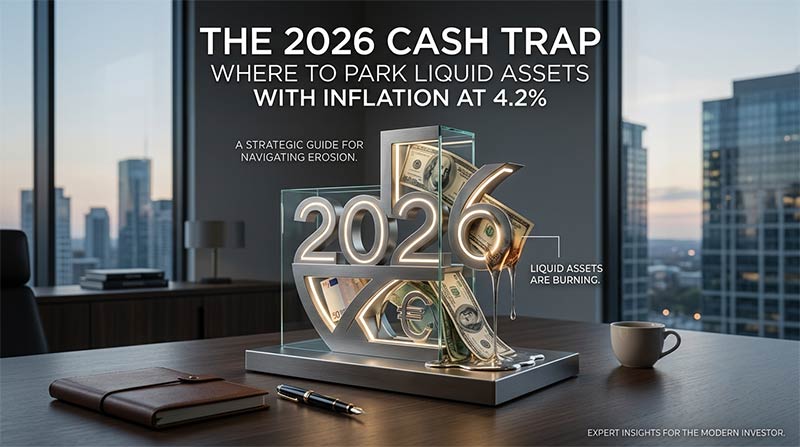
If you are celebrating the 4% yield on your savings account right now, it’s time for a quick reality check.
With consumer price inflation ticking back up to 4.2%, holding cash has quietly become a losing proposition again. The Federal Reserve has paused its rate-cutting cycle, keeping the federal funds rate steady at a target range of 3.50% to 3.75%. While that means yields on cash-like vehicles look high on paper compared to the last decade, they are structurally falling behind the actual rising cost of living.
If your cash strategy is resting entirely on a standard high-yield savings account (HYSA), you are essentially paying a premium for liquidity. To actually protect your purchasing power, you have to look past standard bank products and build a tactical, tax-advantaged cash stack.
Here is a look at the strategies that actually match or beat rising costs right now, along with the exact math behind why they work.
1. Series I Savings Bonds: The Pure Inflation Play
For a long time, Series I Bonds were ignored because their fixed rates sat at 0%. That has changed. For I Bonds issued from May 2026 through October 2026, the U.S. Treasury announced a composite interest rate of 4.26%.
What makes this compelling isn’t just the headline number—it’s how it’s calculated:
- A 0.90% Fixed Rate: This is your “real” return above inflation, and it’s locked in for the entire 30-year life of the bond.
- A 3.34% Annualized Inflation Rate: This component resets every six months based on the CPI-U.
The Catch: You can only buy $10,000 per calendar year per Social Security Number through the government’s TreasuryDirect portal. Furthermore, your money is completely locked for the first 12 months, and giving up the cash before five years cost you the last three months of interest. It isn’t an emergency fund substitute, but it is the cleanest way to guarantee your cash doesn’t lose value.
2. Short-Term Treasury Bills: The Tax-Shield Strategy
If you need liquidity within a few months rather than years, 6-Month Treasury Bills are hovering around a 3.95% yield.
While a 3.95% yield looks like it falls short of 4.2% inflation, T-bills carry a massive structural advantage that most savers overlook: they are exempt from state and local income taxes.
If you live in a high-tax state like California, New York, or New Jersey, earning 4.0% in a traditional bank account can easily drop to a net return of 3.2% after state taxes. Because T-bills avoid this drag, their “tax-equivalent yield” often bypasses even the highest-paying HYSAs on the market. You can purchase them directly through a brokerage account or via automated rolling schedules on TreasuryDirect.
3. High-Yield Savings & Money Market Funds (The Liquidity Layer)
Top-tier online high-yield savings accounts and brokerage money market funds are currently topping out at around 4.10% APY.
This is your absolute baseline. Any cash sitting in a traditional brick-and-mortar bank earning 0.01% is actively melting away. You should use HYSAs strictly for money you expect to spend within the next 30 to 90 days. Treat anything beyond that as an investment allocation that requires better structural positioning.
Comparing the Options Side-by-Side
To map out your cash allocation, you need to balance yield, tax exposure, and timelines. The table below breaks down exactly where each vehicle fits into a defensive portfolio.
| Strategy | Current Yield / Return | Inflation Protection | Tax Treatment | Best Used For |
| Series I Bonds | 4.26% | High (Guaranteed to match CPI + 0.90%) | Deferred Federal tax; Exempt from State/Local tax | Cash you won’t touch for 1 to 5 years. |
| 6-Month T-Bills | ~3.95% | Moderate (Fixed short-term yield) | Subject to Federal tax; Exempt from State/Local tax | Cash needed in 6 months; excellent for high-tax states. |
| Top-Tier HYSAs | Up to 4.10% | Low (Trailing consumer inflation) | Fully taxable at Federal, State, and Local levels | Immediate emergency funds (0–3 months of expenses). |
| Traditional Banks | ~0.01% | None | Fully taxable | Everyday checking and operational cash only. |
How to Build Your Defensive Cash Stack
Blindly chasing the highest yield usually backfires because it ignores your actual liquidity needs. A realistic, inflation-resistant cash stack shouldn’t rely on just one vehicle. Instead, divide your liquid capital into tiers:
- The Immediate Tier (0-3 Months): Keep this in a top-tier HYSA or an institutional money market fund yielding around 4%. This ensures you can pay your bills or handle an unexpected emergency tomorrow without penalties.
- The Rolling Tier (3-12 Months): Build a 4-week or 8-week Treasury Bill ladder. By setting your broker to automatically reinvest maturing bills, a portion of your cash becomes liquid every single month while capturing state-tax exemptions.
- The Core Protection Tier (1-5 Years): Max out your $10,000 annual limit in Series I Bonds. This ensures that a baseline portion of your long-term liquid net worth permanently retains its buying power, regardless of how high inflation spikes over the next few years.
Yield chasing is a game of diminishing returns, but when inflation rests at 4.2%, optimization isn’t optional—it’s standard maintenance.

Want to Make Money From Home ?
Join 55,000+ real, remote ways to make money every week.
Good luck! I hope you find the perfect remote opportunity for your lifestyle and goals.