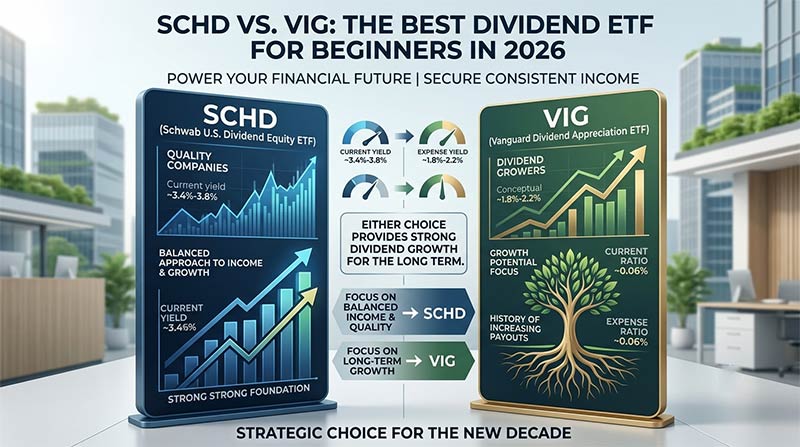
Choosing your first dividend exchange-traded fund (ETF) usually comes down to a battle between two industry giants: the Schwab U.S. Dividend Equity ETF (SCHD) and the Vanguard Dividend Appreciation ETF (VIG).
While both funds target dividend-paying companies, they operate on completely different investment philosophies. SCHD seeks out high current yields backed by fundamental quality, whereas VIG completely ignores high yields to focus on companies with a proven track record of increasing their payouts year after year.
To help you see where these strategies fit, here is how both compare head-to-head alongside the standard S&P 500 index baseline.
| Metric | Schwab SCHD | Vanguard VIG | Vanguard VOO (S&P 500 Baseline) |
| Current Dividend Yield | ~3.2% | ~1.6% | ~1.3% |
| Expense Ratio | 0.06% | 0.04% | 0.03% |
| Number of Holdings | 103 | 341 | 503 |
| Primary Strategy | High yield + financial health | 10+ years of continuous dividend growth | Broad market capitalization |
SCHD: Maximizing Current Cash Flow
The Schwab SCHD ETF tracks the Dow Jones U.S. Dividend 100 Index. It does not just chase high yields blindly; it filters companies through quality screens evaluating cash flow-to-debt ratios, return on equity, and indicated dividend growth rates over time.
- The Yield Advantage: SCHD consistently delivers a yield north of 3%. This makes it a premier choice if your goal is immediate passive income to cover expenses or to manually allocate cash into other investments.
- Value-Oriented Sectors: The portfolio heavily favors financial services, industrials, and consumer defensive stocks. It avoids yield traps by capping individual stock weights and completely excluding Real Estate Investment Trusts (REITs).
- Concentration Profile: With roughly 100 holdings, it is far more concentrated than broader market funds. If value sectors experience a cyclical downturn, SCHD will experience short-term underperformance relative to growth-heavy indexes.
VIG: Total Return and Tech-Driven Payouts
The Vanguard VIG ETF tracks the S&P U.S. Dividend Growers Index. Its baseline requirement is straightforward: a company must have increased its regular annual dividend payment for at least 10 consecutive years. Crucially, the index completely excludes the top 25% highest-yielding companies that qualify.
- The Low-Yield Paradox: Because it cuts out ultra-high yielders, VIG’s current dividend yield sits under 2%—only marginally higher than the S&P 500. You do not buy VIG for large quarterly cash payouts today.
- The Compound Interest Engine: By avoiding capital-intensive, slow-growth legacy companies, VIG captures elite compounders. Tech leaders like Microsoft and Apple—which increase their dividends aggressively but have low stated yields because their stock prices rise so fast—carry significant weight in this fund.
- Broad Diversification: Holding over 340 stocks makes VIG more stable and highly correlated to the broader market, offering a built-in safety net during growth equity pullbacks.
Which ETF Wins for Beginners?
The ideal choice depends entirely on your current financial timeline and your main psychological motivator as an investor.
Choose SCHD if your priority is immediate cash flow
If you are nearing a point where you need your portfolio to fund your lifestyle, or if your primary motivation is watching substantial cash deposits clear into your brokerage account every quarter, SCHD is the clear winner. It maximizes immediate income without sacrificing portfolio quality.
Choose VIG if your priority is long-term wealth accumulation
If you have a decade or more until retirement and do not plan to spend your dividends today, VIG is structurally superior for total return. Its heavy tilt toward technology and secular growth ensures your principal capital grows fast enough to keep pace with the market, while quietly building a high yield-on-cost basis for your future portfolio.

Want to Make Money From Home ?
Join 55,000+ real, remote ways to make money every week.
Good luck! I hope you find the perfect remote opportunity for your lifestyle and goals.