When most investors build a dividend portfolio, they focus entirely on the headline yield. They see an 8% payout and think they are beating the market.
But there is a hidden tax drag that quietly eats away at those gains. Depending on where you live, what you hold, and how long you hold it, your actual return can easily be cut by a third.
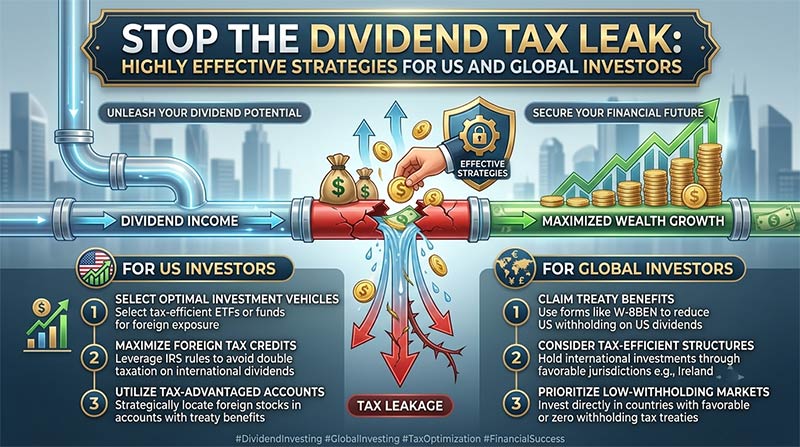
Maximizing your yield means nothing if you do not protect those payouts from the tax collector. Here is exactly how US and international investors can plug the dividend tax leak.
The US Investor’s Playbook: Qualifying Your Dividends
For a US investor, the single biggest factor in your tax bill is whether your dividends are classified as qualified or ordinary (non-qualified).
- Ordinary Dividends: These are taxed at your standard federal income tax bracket, which can run as high as 37%.
- Qualified Dividends: These enjoy preferential rates identical to long-term capital gains—0%, 15%, or 20%.
For example, a couple filing jointly with $250,000 in taxable income will pay 24% on ordinary dividends, but only 15% if those dividends are qualified. On $30,000 of annual dividend income, that single distinction is worth thousands of dollars.
To secure these lower rates, you must navigate the IRS holding period rules.
As shown in the timeline above, you cannot simply buy a stock the day before the Ex-Dividend Date and sell it the day after to pocket a low-tax payout. For Common Stock, the IRS requires you to hold the asset for more than 60 days within a 121-day window. This window starts 60 days before the ex-dividend date and ends 60 days after.
If you trade in and out of a stock too quickly, your dividend instantly loses its qualified status and is taxed at your highest marginal rate. You can check the current criteria on Fidelity’s guide on qualified dividends or reference IRS Topic 404.
The Global Trap: Withholding Taxes (WHT)
If you are an international investor buying US equities, or a US investor buying international equities, you face cross-border taxation.
By default, the US imposes a flat 30% withholding tax on all US-source dividends paid to non-resident foreign investors. This tax is deducted automatically before the money ever hits your brokerage account.
The most effective way to lower this rate is to leverage Double Taxation Treaties (DTTs).
- For Non-US Investors Buying US Stocks: If your country has a tax treaty with the US, you can file a Form W-8BEN through your broker. This typically slashes the withholding tax from 30% down to 15% (or even lower for certain jurisdictions).
- For US Investors Buying Foreign Stocks: Many foreign nations will withhold taxes on dividends paid to you. To prevent being taxed twice, the US allows you to claim the Foreign Tax Credit (FTC) on your tax return. For most investors, this is filed using IRS Form 1116, allowing you to offset your US tax liability dollar-for-dollar by the amount you paid abroad.
The Comparison: How Different Portfolios Are Taxed
Tax rules vary wildly depending on who you are and what you hold. The table below compares the tax impact and the best structural fixes for the three most common investor scenarios.
| Investor & Asset Class | Default Tax Treatment | The Specific Tax Leak | The Efficient Strategy |
| US Investor holding US Stocks | Marginal income rates on ordinary dividends; capital gains rates on qualified. | Short holding periods or holding Real Estate Investment Trusts (REITs) in taxable accounts. | Keep high-yielding ordinary dividend payers (like REITs) in a traditional or Roth IRA. |
| US Investor holding Foreign Stocks | Subject to foreign withholding taxes (typically 15% to 30%). | Double taxation if foreign taxes paid are not claimed on US tax returns. | Hold international stocks in a taxable account to claim the Foreign Tax Credit (FTC). |
| Non-US Investor holding US Stocks | Flat 30% US withholding tax on all dividends. | Paying the full 30% because of incorrect paperwork or poor fund domicile. | File Form W-8BEN to claim treaty rates, or buy Irish-domiciled UCITS ETFs. |
Advanced Structuring: The “Irish-Domiciled” ETF Loophole
For international investors who do not live in a country with a highly favorable US tax treaty, buying US stocks directly is highly inefficient.
Instead, the smart play is to invest through an Irish-domiciled UCITS Exchange-Traded Fund (ETF).
Ireland has an exceptionally strong tax treaty with the US. Because of this treaty, any US-source dividends paid to an Irish-domiciled ETF are taxed at a reduced 15% withholding rate inside the fund, rather than the standard 30%.
If you buy a US-domiciled ETF (like VOO or SPY) as a foreign investor, you will pay 30% withholding on the distributions. If you buy the exact same index via an Irish-domiciled equivalent (like VUAA or CSPX), you instantly cut your dividend tax drag in half.
Summary of Key Portfolio Fixes
To maximize your long-term wealth, make these structural adjustments part of your regular portfolio review:
- Audit your holding periods: If you are buying dividend stocks, commit to holding them for at least 61 days around the ex-dividend date to lock in qualified tax rates.
- Locate assets intelligently: Place ordinary income generators (REITs, high-yield corporate bonds) inside tax-advantaged accounts like IRAs or 401(k)s. Keep qualified dividend payers in your taxable brokerage accounts where they can benefit from lower capital gains rates.
- Check your ETF domiciles: If you are a non-US resident, favor Irish-domiciled funds over US-domiciled funds to shield your portfolio from the 30% withholding tax.

Want to Make Money From Home ?
Join 55,000+ real, remote ways to make money every week.
Good luck! I hope you find the perfect remote opportunity for your lifestyle and goals.
Disclaimer and Risk Warning
Financial Disclaimer: The content published on this page is intended solely for educational, informational, and editorial purposes and does not constitute formal financial, legal, tax, or investment advice. The financial thresholds, metrics, and strategies outlined are generalized guidelines and may not align with your specific financial goals, time horizons, or personal risk tolerances.
Risk Warning: All forms of financial investment—including traditional public stocks, foreign exchange trading, digital real estate crowdfunding, and alternative trust investments—carry inherent risks, including the potential loss of your entire initial principal. Payout yields, dividend distributions, and platform interest rates are never legally guaranteed and can be reduced, frozen, or entirely dissolved at any time without warning. Past performance does not serve as a reliable indicator of future market movements. Always perform meticulous independent due diligence or consult with a certified, fiduciary financial advisor before deploying capital into any market.