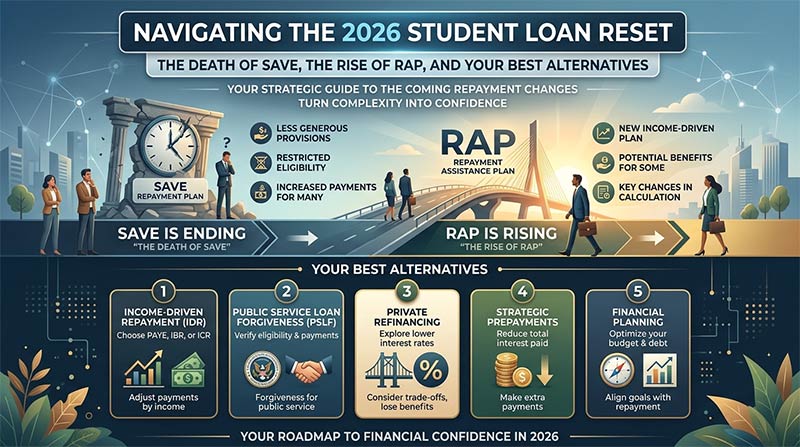
The federal student loan landscape didn’t just shift this year—it was completely rebuilt. Following a federal court order on March 10, 2026, that permanently terminated the Saving on a Valuable Education (SAVE) plan, the Department of Education has rolled out the largest structural overhaul of student aid in decades.
Under the One Big Beautiful Bill Act (OBBB)—passed in late 2025 and fully effective as of July 1, 2026—the rules governing borrowing limits, repayment plans, and eventual debt forgiveness have fundamentally changed. If you are one of the millions of borrowers currently sitting in mandatory forbearance or holding older federal loans, passive waiting is no longer an option.
Here is what you actually need to know to navigate the new system, minimize your monthly payments, and avoid automatic default traps.
The 90-Day Clock: Transitioning Off the Defunct SAVE Plan
If you were one of the seven million borrowers enrolled in the SAVE plan, your mandatory forbearance period is coming to an end. Since July 1, 2026, loan servicers (such as MOHELA and Nelnet) have been sending out official transition notices in waves.
Once you receive your notice, you have exactly 90 days to manually select a new, legally compliant repayment plan.
If you fail to act before your 90-day window closes, your servicer will automatically enroll you in either the traditional Standard Repayment Plan or the new Tiered Standard Plan. Because standard plans do not take your income into account, this could instantly skyrocket your monthly payment.
Note: If you are working toward Public Service Loan Forgiveness (PSLF), you must actively switch to an eligible IDR plan during this 90-day window to ensure your future payments continue to count toward your 120-payment forgiveness target.
The New Repayment Landscape: RAP vs. Legacy Plans
The OBBB Act has simplified federal repayment options down to two primary tracks for any new loans disbursed after July 1, 2026: the Repayment Assistance Plan (RAP) and the Tiered Standard Plan.
While RAP is designed as the primary income-driven repayment (IDR) option moving forward, it is structurally very different—and generally more expensive—than the older IDR plans it replaces.
Comparing the Main 2026 Repayment Options
To help you weigh your options, here is how the new RAP compares to traditional Income-Based Repayment (IBR) and the new Tiered Standard Plan:
| Repayment Plan | How Payments Are Calculated | Forgiveness Timeline | Key Interest & Principal Rules |
| Repayment Assistance Plan (RAP) | Sliding scale up to 10% of your Adjusted Gross Income (AGI), minus $50 per dependent. Minimum payment is $10 (no $0 option). | 30 years of qualifying payments. | Cancels unpaid monthly interest; offers up to $50/month principal reduction for qualifying borrowers. |
| Income-Based Repayment (IBR) | 10% to 15% of discretionary income. $0 payments are possible for low earners. | 20 to 25 years. | Unpaid interest may capitalize if you leave the plan. |
| Tiered Standard Plan | Fixed monthly payments based entirely on your total outstanding balance, not your income. | No forgiveness; the loan is fully paid off at the end of the term. | Fixed terms of 10, 15, 20, or 25 years. Interest accrues normally. |
Note: Legacy IDR plans like PAYE (Pay As You Earn) and ICR (Income-Contingent Repayment) are officially phasing out. If you are already enrolled in PAYE or ICR and do not take out new loans, you can remain on them until July 1, 2028, at which point you must transition to IBR or RAP.
The Sunset of Grad PLUS and New Borrowing Limits
For students currently in or planning for graduate school, the financial strategy has completely changed.
- Grad PLUS Loans Eliminated: As of July 1, 2026, Grad PLUS loans are no longer available for new borrowers. If you already had a Grad PLUS loan before this date, you are grandfathered in for up to three years (or until you finish your current program) to complete your degree.
- New Graduate Borrowing Caps: Without Grad PLUS, graduate students must rely on Unsubsidized Direct Loans, which now have strict caps:
- Professional programs (e.g., medicine, law): Capped at $50,000 per year, with a $200,000 lifetime limit.
- All other graduate programs: Capped at $20,500 per year, with a $100,000 lifetime limit.
Because you can no longer simply “borrow up to the cost of attendance” via federal loans, many graduate students will have to look to private alternatives, employer assistance, or institutional aid to cover funding gaps.
The Re-emergence of the “Tax Bomb”
Perhaps the most critical financial change of 2026 is the tax treatment of forgiven student debt.
The temporary federal tax exemption for student loan forgiveness expired on December 31, 2025. Beginning January 1, 2026, any balance forgiven under an IDR plan (including RAP and IBR) is once again treated as taxable income by the IRS.
For example, if you have $50,000 in student debt forgiven after 25 or 30 years, that $50,000 will be added to your taxable income for that year, resulting in a potentially massive tax bill. Public Service Loan Forgiveness (PSLF) remains a notable exception—it is still completely tax-free at the federal level.
Immediate Action Steps: How to Minimize Costs Right Now
If you want to protect your wallet from the 2026 reset, take these three steps immediately:
- Lock in the 1% Auto-Pay Discount: To ease the transition, the Department of Education is offering a temporary interest rate reduction of 1% (up from the usual 0.25%) for borrowers enrolled in auto-pay. You must enroll by September 30, 2026, to secure this benefit, which will run through June 30, 2028. Log in to your account at StudentAid.gov to set this up.
- Review Your Forgiveness Progress: Because the federal government paused and then retired the official payment tracking tool, you must rely on your servicer to verify your payment count. Contact your servicer directly to request an audit of your qualifying payments toward IBR or PSLF.
- Download and Secure Your Payment History: Given the ongoing administrative chaos and servicer transitions, protect yourself by downloading your entire federal student aid history. Go to your Federal Student Aid Dashboard, navigate to “My Aid,” and click “Download My Aid Data”. Keep these records safe in case your servicer makes an accounting error during your plan transition.

Want to Make Money From Home ?
Join 55,000+ real, remote ways to make money every week.
Good luck! I hope you find the perfect remote opportunity for your lifestyle and goals.
Disclaimer and Risk Warning
Financial Disclaimer: The content published on this page is intended solely for educational, informational, and editorial purposes and does not constitute formal financial, legal, tax, or investment advice. The financial thresholds, metrics, and strategies outlined are generalized guidelines and may not align with your specific financial goals, time horizons, or personal risk tolerances.
Risk Warning: All forms of financial investment—including traditional public stocks, foreign exchange trading, digital real estate crowdfunding, and alternative trust investments—carry inherent risks, including the potential loss of your entire initial principal. Payout yields, dividend distributions, and platform interest rates are never legally guaranteed and can be reduced, frozen, or entirely dissolved at any time without warning. Past performance does not serve as a reliable indicator of future market movements. Always perform meticulous independent due diligence or consult with a certified, fiduciary financial advisor before deploying capital into any market.