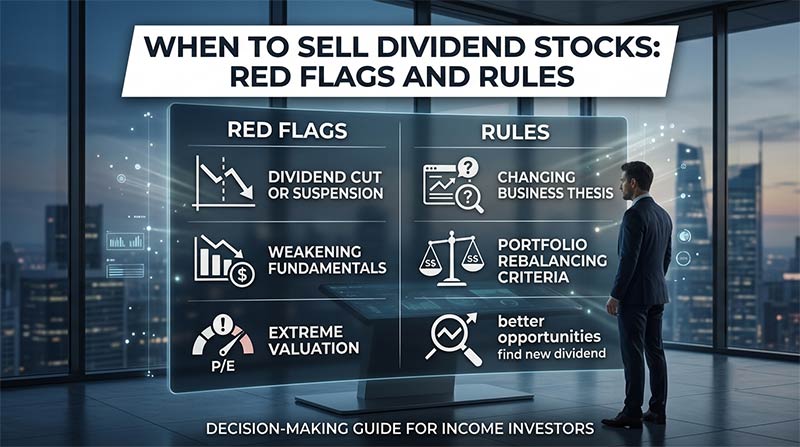
The classic playbook for income investing tells you to buy great companies and hold them forever. But “forever” is an aspiration, not a strategy. There are times when holding onto a deteriorating dividend stock will destroy your capital faster than the quarterly checks can rebuild it.
Selling a dividend stock isn’t about panic; it’s about capital preservation. When a business model cracks, the dividend is often the last thing management cuts, but the market usually prices in the disaster months in advance.
To protect your portfolio, you need an objective framework for when to pull the plug.
The Primary Red Flags: Spotting Dividend Distress
The moment a company’s dividend yield spikes, it’s rarely because management is feeling generous. Most often, the stock price has cratered because institutional investors see trouble ahead. Look at these structural red flags before the dividend cut is officially announced.
1. The Payout Ratio Exceeds the Danger Zone
The dividend payout ratio—the percentage of net income paid out to shareholders—is your first line of defense.
- For standard corporations: A payout ratio over 80% means the company has zero margin for error if earnings drop.
- For Utilities and REITs: These business models are structurally different. Real Estate Investment Trusts are legally required to distribute at least 90% of taxable income, making high ratios normal. But for a standard tech or consumer stock, a persistently sky-high payout ratio is unsustainable.
2. Free Cash Flow Divergence
Earnings can be manipulated by accounting tricks; free cash flow (FCF) cannot. If net income looks fine but free cash flow is shrinking, the company is using debt or burning through cash reserves to pay you. A dividend paid via a credit card is a ticking time bomb.
3. Structural Moat Erosion
Recent market shifts highlight how quickly legacy giants can fall when their core competitive advantage evaporates. When structural changes—like shifting consumer tech preferences or cheaper foreign competition—permanently impair earnings power, the dividend becomes a secondary concern. The company needs to hoard cash to pivot; keeping the dividend is a luxury they can no longer afford.
When to Sell: The Core Rules of Thumb
Instead of letting emotions dictate your next move, rely on clear financial boundaries. The following baseline metrics contrast a healthy, sustainable position against an asset that warrants an immediate exit.
| Metric | Healthy Zone (Hold) | Danger Zone (Sell) |
| Payout Ratio (Standard Stock) | 35% to 65% | Greater than 80% |
| Dividend Coverage Ratio | Greater than 2.0x | Less than 1.5x |
| Free Cash Flow Growth | Steady or rising alongside dividends | Negative or trailing dividend growth for 3+ quarters |
| Balance Sheet Debt (Gearing) | Under 50% debt-to-equity | Exceeding 100% or rising rapidly to fund operations |
| Core Business Fundamentals | Stable market share and pricing power | Declining margins and permanent structural revenue loss |
The “Good” Reasons to Sell
Not every sale happens because a company is failing. Sometimes, selling a healthy dividend payer is simply smart portfolio management.
- The Position Has Grown Too Large: If an individual stock grows to occupy more than 8% to 10% of your total portfolio value, a single piece of bad news can derail your net worth. Trimming a winner back down to a comfortable 4% or 5% allocation preserves diversification.
- Extreme Valuation: If the broader market experiences a speculative bubble and your defensive stock starts trading at an tech-like price-to-earnings (P/E) multiple, the forward yield drops to negligible levels. Selling at the top lets you capture massive capital gains that would take decades to match in dividend checks.
- A Better Reinvestment Allocation: Capital is finite. If you find an alternative asset with equal safety but significantly better growth prospects or a higher sustainable yield, moving the money is a logical pivot.
The Cost of Waiting for the Cut
Many investors hesitate to sell because they don’t want to “lose the income.” This is a cognitive trap. Historical data from major financial institutions like Charles Schwab and Morningstar consistently shows that when a company slashes its payout, the stock price drops violently on the news.
By waiting for the official press release, you suffer a double blow: your income stream evaporates, and your principal capital is devastated. Treat a rising yield accompanied by declining fundamentals as a clear warning. If the underlying metrics break your rules, take your capital out before the trap snaps shut.

Want to Make Money From Home ?
Join 55,000+ real, remote ways to make money every week.
Good luck! I hope you find the perfect remote opportunity for your lifestyle and goals.
Disclaimer and Risk Warning
Financial Disclaimer: The content published on this page is intended solely for educational, informational, and editorial purposes and does not constitute formal financial, legal, tax, or investment advice. The financial thresholds, metrics, and strategies outlined are generalized guidelines and may not align with your specific financial goals, time horizons, or personal risk tolerances.
Risk Warning: All forms of financial investment—including traditional public stocks, foreign exchange trading, digital real estate crowdfunding, and alternative trust investments—carry inherent risks, including the potential loss of your entire initial principal. Payout yields, dividend distributions, and platform interest rates are never legally guaranteed and can be reduced, frozen, or entirely dissolved at any time without warning. Past performance does not serve as a reliable indicator of future market movements. Always perform meticulous independent due diligence or consult with a certified, fiduciary financial advisor before deploying capital into any market.