The days of buying a broad S&P 500 index fund and cruising on autopilot are hitting a serious roadblock. In 2026, the market is historically top-heavy, with the top ten holdings accounting for more than one-third of the entire index’s value. This extreme concentration means index investors are carrying massive single-stock risk, with individual names like Nvidia making up nearly 18% of some tech portfolios.
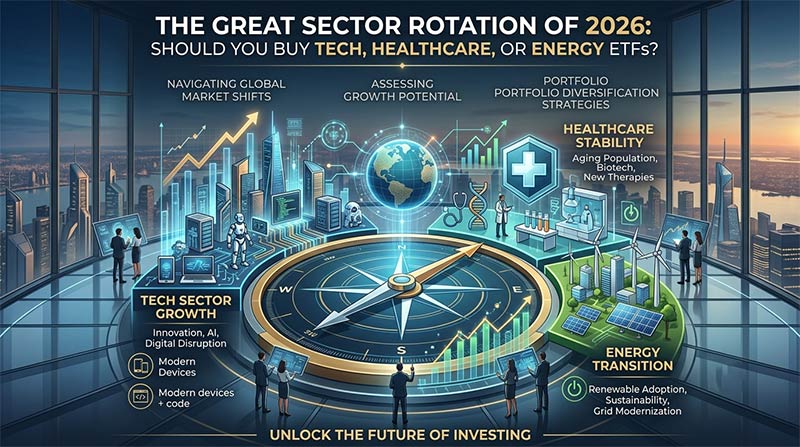
If you want to manage this top-heavy exposure or tilt your portfolio toward better relative value, rotating into sector-specific index funds is the strategic play. But where should your money go? Tech is navigating a selective correction, healthcare is waking up from a multi-year slumber, and energy is quietly fueling the data centers that make modern tech possible.
Technology: The Shift from Broad Software to Hardware Infrastructure
While technology remains the long-term engine of the global economy, the broad sector is experiencing a significant division in 2026. General software and broad-market tech ETFs are struggling with minor pullbacks. However, semiconductor and hardware infrastructure funds continue to post massive gains.
- The Concentration Trap: Broad tech funds like the Fidelity MSCI Information Technology Index ETF (FTEC) offer incredibly cheap exposure (0.084% expense ratio) but hold over 50% of their assets in just three names: Nvidia, Apple, and Microsoft.
- The Selective Strategy: Analysts in VanEck’s Q3 2026 Outlook advise to “stay invested but be selective”. The smart play here is a core-satellite setup—using a low-fee broad tech ETF as your base and layering in specialized semi or cybersecurity funds to capture pure thematic growth.
Healthcare: The Defensive Growth Sleeper Finally Wakes Up
Healthcare spent the last few years lagging behind mega-cap tech, but 2026 is shaping up to be its major comeback year. A combination of rock-solid defensive characteristics and explosive clinical innovations has triggered massive inflows into healthcare ETFs.
- Clearing Regulatory Hurdles: Policy uncertainty regarding drug pricing and tariffs created a heavy drag on healthcare valuations. Now that these regulatory guidelines have stabilized, institutional capital is rapidly rotating back into the sector.
- The Growth Drivers: The structural story for healthcare remains bulletproof: an aging global population and secular demand for GLP-1 weight-loss drugs, advanced medical devices (MedTech), and AI-integrated diagnostics.
- The Best Play: Broad sector index funds like the Health Care Select Sector SPDR (XLV) offer a classic blend of defensive resilience and innovation. Because people need medical services regardless of economic conditions, this sector remains an excellent shock absorber for volatile times.
Energy: Capitalizing on the AI Power Crunch
The energy sector is no longer just a cyclical play on oil prices. In 2026, the explosive growth of artificial intelligence and physical data centers has created an unprecedented global power crunch.
- The Electricity Demand Boom: The International Energy Agency expects global power demand to grow by 3.7% in 2026, driven directly by AI data centers and rising industrial activity. This structural shift requires massive upgrades to both the traditional power grid and renewable energy infrastructures.
- Value and Cash Flow: Traditional fossil fuel producers continue to operate as highly profitable cash cows. The Vanguard Energy ETF (VDE) offers exposure to integrated giants like ExxonMobil and Chevron at a highly reasonable 20.8x P/E ratio, while paying out a solid 2.66% dividend yield.
- The Clean Energy Milestone: On the green side, utility-scale battery costs have fallen below $100/kWh in 2026, creating cost parity between clean energy storage and internal combustion engines.
Comparing the Sectors for 2026
When choosing where to allocate your capital, you must balance immediate yield, concentration risk, and the underlying macroeconomic catalysts.
| Sector | Core ETF Play | Primary 2026 Catalyst | Key Risk | Average P/E |
| Technology | FTEC / XLK | AI infrastructure & hardware demand | Extreme single-stock concentration | High (~30x+) |
| Healthcare | XLV / VHT | Demographic aging & GLP-1 expansion | Regulatory pricing intervention | Moderate (~18x-20x) |
| Energy | VDE / XLE | Data center power demand & grid overhaul | Commodity price volatility | Low-to-Moderate (20.8x) |
Finding Your Ideal Allocation
Before shifting your capital into sector-specific funds, it is crucial to align your choices with your personal financial profile.
To help tailor this strategy, consider these three questions:
- What is your geographic tax status? (U.S. investors, for example, must navigate wash-sale rules when swapping similar ETFs like VGT and FTEC in taxable accounts).
- What is your overall target asset mix? (Are these sector funds replacing a portion of your core broad-market holdings or acting as speculative satellites?)
- What is your risk tolerance? (Are you comfortable with the high volatility of tech, or do you prefer the defensive dividend cushion of healthcare and energy?)
If you are looking for a balanced, all-weather approach in 2026, consider allocating 50% of your sector tilt to Healthcare (XLV) for defensive growth, 30% to Energy (VDE) for cash-flow generation and grid exposure, and 20% to Technology (FTEC) to capture highly targeted AI innovation without over-exposing yourself to single-stock volatility.

Want to Make Money From Home ?
Join 55,000+ real, remote ways to make money every week.
Good luck! I hope you find the perfect remote opportunity for your lifestyle and goals.
Disclaimer and Risk Warning
Financial Disclaimer: The content published on this page is intended solely for educational, informational, and editorial purposes and does not constitute formal financial, legal, tax, or investment advice. The financial thresholds, metrics, and strategies outlined are generalized guidelines and may not align with your specific financial goals, time horizons, or personal risk tolerances.
Risk Warning: All forms of financial investment—including traditional public stocks, foreign exchange trading, digital real estate crowdfunding, and alternative trust investments—carry inherent risks, including the potential loss of your entire initial principal. Payout yields, dividend distributions, and platform interest rates are never legally guaranteed and can be reduced, frozen, or entirely dissolved at any time without warning. Past performance does not serve as a reliable indicator of future market movements. Always perform meticulous independent due diligence or consult with a certified, fiduciary financial advisor before deploying capital into any market.