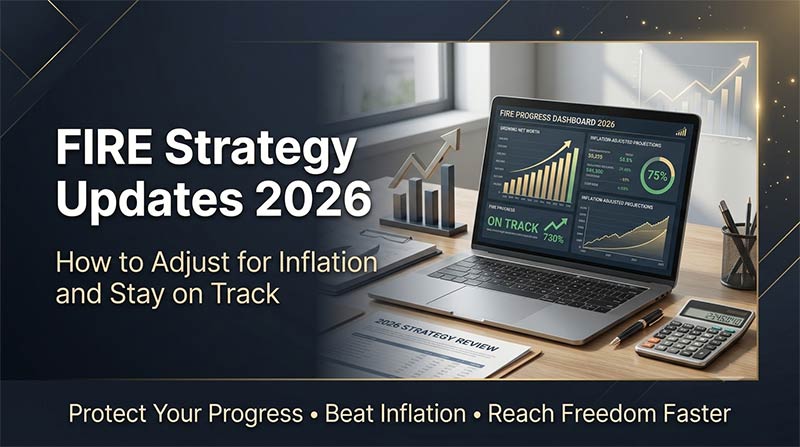
For over a decade, the path to early retirement seemed deceptively straightforward: save aggressively, invest in low-cost index funds, accumulate 25 times your annual expenses, and live off a 4% annual withdrawal rate. But the economic turbulence of recent years delivered a stark reality check. The post-pandemic surge in living costs and sticky core inflation forced the early retirement community to confront a critical truth: static models fail when purchasing power erodes faster than expected.
As we navigate the economic landscape of 2026, FIRE early retirement inflation adjustments 2026 have shifted from a niche theoretical debate into an absolute necessity. With persistent core inflation hovering above historic targets, rising healthcare premiums, and structural shifts in global supply chains, early retirees facing 40-to-50-year retirement horizons cannot afford to rely on outdated assumptions. A portfolio calculated on 2019 prices simply won’t sustain the same lifestyle today without proactive strategy tweaks.
In reviewing financial plans for aspiring and current early retirees, I’ve found that the biggest risk isn’t market volatility—it’s the silent, compounding drag of purchasing power loss during the early years of retirement. The good news? Financial independence is far from dead. However, the rulebook requires an update.
This comprehensive guide breaks down how to adapt your FIRE strategy inflation proofing for 2026. We will re-examine traditional safe withdrawal rates, explore dynamic spending guardrails, optimize portfolio allocations against inflation, and highlight the critical adjustments you must make today to ensure your nest egg lasts a lifetime.
1. The Traditional FIRE Blueprint vs. Modern Inflation Realities
To understand why early retirement adjustments for inflation are essential today, we must first look at the foundation of the FIRE movement: the Trinity Study. Published in 1998, this landmark paper analyzed historical stock and bond returns over 30-year rolling periods to determine how much a retiree could withdraw annually without running out of money.
The study gave birth to two foundational FIRE concepts:
- The 4% Rule: In your first year of retirement, you withdraw 4% of your total portfolio. In each subsequent year, you adjust that initial dollar amount upward to keep pace with inflation (CPI).
- The Rule of 25: To retire, you need a portfolio equal to 25 times your anticipated initial annual expenses ($100,000 annual spending = $2.5 million target portfolio).
While the Trinity Study was revolutionary, its traditional application suffers from three structural vulnerabilities in today’s environment:
- Unrealistic Time Horizons: The original study tested a 30-year retirement for standard retirees leaving the workforce at age 65. If you retire at 35, 40, or 50, your portfolio must last 40 to 60 years. Over six decades, even mild inflation exerts an enormous compounding toll.
- Standard CPI vs. Personal Inflation: The Consumer Price Index (CPI-U) tracks a generic basket of goods for an urban household. Early retirees experience a radically different “personal CPI.” You spend higher percentages of your budget on healthcare, experiences, travel, and real estate maintenance—categories that routinely inflate faster than headline CPI.
- Sequence of Returns and Inflation Risk (SRIR): The most dangerous financial cocktail for an early retiree is a market downturn combined with high inflation during the first 5–10 years of retirement. Withdrawing higher nominal dollar amounts from a shrinking portfolio permanently destroys capital, accelerating portfolio depletion.
2. How Inflation Specifically Erodes Early Retirement Plans
Understanding FIRE movement 2026 inflation risks requires recognizing how compounding works in reverse. Inflation isn’t just a minor surcharge on your morning coffee; it is exponential interest working against your purchasing power.
Consider a baseline annual budget of $60,000 in early retirement:
- At a historic 2.0% average annual inflation rate, your required nominal spending doubles to $120,000 in 35 years.
- At a persistent 3.5% average annual inflation rate, that same $60,000 lifestyle requires $200,000 in 35 years.
- At a high 5.0% average annual inflation rate, your necessary budget expands to an astounding $330,000 in 35 years.
If your portfolio does not generate real (after-inflation) total returns that outpace these adjustments, your baseline withdrawal rate steadily climbs, turning a conservative 3.5% starting rate into an unsustainable 7% or 8% effective draw down the road.
Furthermore, inflation affects early retirees asymmetricly across spending categories:
- Healthcare: Health insurance premiums, deductibles, and out-of-pocket medical costs consistently outpace general CPI by 2% to 4% annually.
- Property Taxes & Housing Maintenance: Homeownership costs, insurance, and contractor labor have experienced massive post-2020 structural price step-ups that show no signs of reverting.
- Discretionary Travel & Leisure: Airfare, hospitality, and dining out—core components of an active early retirement—are highly sensitive to wage push inflation and service supply constraints.
3. Key FIRE Adjustments for 2026
If static rules of thumb no longer provide bulletproof safety, what concrete changes should you make? Here are the five key structural early retirement adjustments for inflation to implement in 2026.
       TRADITIONAL FIRE MODEL (Pre-2022)                 MODERN INFLATION-RESILIENT FIRE (2026+)
┌─────────────────────────────────────────────┐        ┌─────────────────────────────────────────────┐
│ • Static 4% Withdrawal Rate                 │        │ • Dynamic SWR (3.0% - 3.5% Baseline)        │
│ • Simple 25x Annual Expenses Target         │  ───►  │ • 28x - 33x Expenses + Flexible Guardrails  │
│ • Fixed 80/20 Stock/Bond Allocation         │        │ • Diversified Real Assets & TIPS Buffer     │
│ • Linear Expense Escalation                 │        │ • Category-Specific "Personal CPI" Models   │
└─────────────────────────────────────────────┘        └─────────────────────────────────────────────┘
A. Updating Safe Withdrawal Rates (SWR)
The era of assuming a blanket 4% safe withdrawal rate for a 50-year horizon is effectively over. In plans I’ve reviewed, relying on a static 4% rate during periods of elevated valuation and sticky inflation leads to unacceptably high failure rates in long-term Monte Carlo simulations.
- Ultra-Early Retirees (Ages 30–45): Target a baseline safe withdrawal rate inflation floor of 3.0% to 3.25% (a 31x to 33x expense multiplier).
- Mid-Life Retirees (Ages 46–55): Target a baseline SWR of 3.3% to 3.5% (a 28x to 30x expense multiplier).
- Standard Early Retirees (Ages 56–62): A 3.5% to 3.75% rate remains viable, particularly if you have incoming pension or Social Security backstops.
B. Portfolio Allocation Overhaul
Traditional 60/40 stock/bond portfolios suffered severe losses during recent high-inflation shocks because rising interest rates drove bond prices down at the exact same time equities slid. In 2026, early retirees need a multi-layered asset allocation designed to capture growth while insulating against price shocks:
- Pricing-Power Equities (55%–70%): Broad-market domestic and international equities (such as total market index funds and dividend-growth strategies). Companies with strong pricing power can pass rising costs directly to consumers, preserving corporate earnings in real terms. Learn more in our detailed guide on investing strategies for long-term growth.
- Inflation-Protected Securities (10%–15%): Treasury Inflation-Protected Securities (TIPS) and US Savings I-Bonds. Holding a dedicated TIPS ladder matched to your first 5–10 years of essential expenses creates a guaranteed, inflation-indexed cash flow floor.
- Short-Duration Cash/Yield Buffer (2–3 Years of Expenses): Keep 24 to 36 months of living expenses in high-yield savings accounts (HYSA), short-term Treasury bills, or money market funds. This buffer prevents you from having to sell equities during a temporary market downturn accompanied by high inflation.
- Real Assets & Commodities (5%–10%): Real Estate Investment Trusts (REITs), physical real estate, or direct infrastructure exposure. Real estate provides a dual inflation hedge through property appreciation and inflation-linked rental income growth.
C. Strategic Social Security Timing
Many FIRE followers ignore Social Security entirely in their early planning, viewing it as a distant bonus. In an inflationary regime, this is a major analytical mistake.
Social Security is one of the few true inflation-indexed, government-backed lifetime annuities available. Every year you delay claiming Social Security past your Full Retirement Age (up to age 70), your benefit grows by approximately 8% per year plus annual Cost-of-Living Adjustments (COLA).
Delaying Social Security to age 70 acts as a powerful “longevity and inflation insurance policy.” It drastically reduces the portfolio withdrawal burden in your late 70s, 80s, and 90s, allowing you to draw down your investment portfolio more confidently during early retirement.
D. Healthcare & Insurance Cost Modeling
Healthcare remains the single largest wild card in early retirement planning. To insulate your portfolio from medical hyperinflation prior to Medicare eligibility at age 65:
- Optimize for ACA Subsidies: Structure your retirement withdrawals to manage your Modified Adjusted Gross Income (MAGI). By utilizing tax-free Roth withdrawals or taxable brokerage basis, you can keep your MAGI in the sweet spot for Affordable Care Act (ACA) premium tax credits.
- Max Out Health Savings Accounts (HSAs): If you are eligible, maximize HSA contributions before retiring. Treat your HSA as an investment account—pay current medical expenses out-of-pocket if possible, let the HSA compound tax-free in low-cost index funds, and reimburse yourself tax-free years down the road during higher-inflation years. Explore our guide on best retirement accounts for FIRE for step-by-step account structuring.
E. Differentiating Baseline vs. Discretionary Spending
One of the most effective hedges against inflation is structural budget elasticity. Instead of viewing your annual spending as a single monolithic number (e.g., $70,000/year), split your budget into two distinct tiers:
- Tier 1: Essential Expenses (Baseline): Housing, basic groceries, utilities, insurance, essential transportation, and healthcare. This tier must be fully covered by low-risk, predictable income and conservative withdrawal rates.
- Tier 2: Discretionary Expenses (Flexible): International travel, luxury dining, home upgrades, and high-end entertainment. This tier can be scaled back by 20% to 50% during periods of high inflation or down market cycles.
4. Practical Strategies to Beat Inflation in 2026
To keep your plan robust without indefinitely delaying your quit date, consider adopting dynamic strategies that adjust naturally as economic conditions evolve.
1. Dynamic Withdrawal Strategies (Guardrail Approach)
Instead of rigidly adjusting your withdrawals by CPI every year regardless of portfolio performance, adopt a dynamic framework like the Guyton-Klinger Guardrails Method:
- Capital Preservation Rule: If your current withdrawal rate rises more than 20% above your initial target rate (due to a market drop or high inflation), cut your discretionary spending by 10%.
- Prosperity Rule: If your withdrawal rate falls more than 20% below your target rate (due to strong market gains), increase your spending to enjoy your wealth.
What I’ve seen work best in practice is setting a simple rule: In years when inflation exceeds 4% AND your investment portfolio ends the year in the red, skip your annual CPI raise for discretionary spending. Skipping just one or two annual inflation adjustments over a decade dramatically extends portfolio survival.
2. Geographic Arbitrage (Domestic & International)
If localized inflation makes your current city unsustainable, geographic arbitrage remains one of the fastest ways to reset your FIRE math:
- Domestic Geo-Arbitrage: Relocating from a high-cost-of-living (HCOL) area (e.g., San Francisco, New York) to a medium- or low-cost area (MCOL/LCOL) reduces fixed baseline expenses like property taxes, state income tax, and basic services.
- International Geo-Arbitrage (Slowmad FIRE): Spending 3 to 6 months per year in regions with lower labor and healthcare costs (e.g., Southern Europe, Southeast Asia, Latin America) drastically cuts annual cash burn while enriching your retirement experience.
3. “Barista FIRE” and Strategic Side Income
The math behind earning even a modest income in early retirement is astonishing. Generating $15,000 per year through consulting, passion projects, or part-time work has the exact same impact on your portfolio as adding $428,500 to your net worth (at a 3.5% withdrawal rate).
   ANNUAL SIDE INCOME         PORTFOLIO EQUIVALENT (At 3.5% SWR)
┌──────────────────────┐    ┌───────────────────────────────────┐
│       $5,000         │ ─► │             $142,857              │
│      $10,000         │ ─► │             $285,714              │
│      $15,000         │ ─► │             $428,571              │
│      $25,000         │ ─► │             $714,285              │
└──────────────────────┘    └───────────────────────────────────┘
Earning supplemental income during the first 5 years of early retirement entirely eliminates sequence-of-returns risk and completely absorbs any short-term inflation spikes.
4. Tax-Efficient Withdrawal Sequences
Tax drag compounds inflation drag. By optimizing which accounts you draw from, you minimize unnecessary income tax, keeping more money in your compounding bucket:
- Taxable Brokerage Accounts First: Live off long-term capital gains and qualified dividends, which are taxed at preferential lower rates (often 0% or 15% depending on taxable income thresholds).
- Roth IRA Conversions / Withdrawals Second: Utilize tax-free Roth IRA contributions and earnings to supplement income without triggering higher tax brackets or ACA subsidy cutoffs.
- Tax-Deferred Accounts (Traditional IRA / 401k) Last: Delay tax-deferred withdrawals until required minimum distributions (RMDs) or during lower-income years to keep tax brackets low.
Detailed spending breakdowns and cash flow sequencing are covered in our complete guide to budgeting for early retirees.
5. Inflation & Withdrawal Rate Scenarios Compared
To visualize how different inflation rates, withdrawal strategies, and portfolio allocations interact over a 40-year early retirement horizon, review the scenario matrix below:
| Scenario | Average Annual Inflation | Starting Withdrawal Rate | Portfolio Allocation (Stocks / Bonds / Cash / Real Assets) | Spending Strategy | 40-Year Portfolio Survival Probability | Key Takeaway / Action |
| A: Legacy Standard | 2.0% | 4.0% | 80% / 20% / 0% / 0% | Static (Unadjusted CPI increase every year) | ~82% | High vulnerability to early bad years; low buffer. |
| B: Inflation Shock (Static) | 3.8% | 4.0% | 70% / 30% / 0% / 0% | Static (Full CPI adjustment annually) | ~61% | High Risk of Failure. Inflation erodes capital rapidly. |
| C: Conservative Adjusted | 3.5% | 3.25% | 70% / 15% / 5% / 10% | Semi-Flexible (Cap CPI raises at max 3%/yr) | ~94% | Lower starting rate provides massive insulation. |
| D: Dynamic Guardrails | 3.8% | 3.5% | 65% / 15% / 10% / 10% | Guyton-Klinger Guardrails (-10% cut in bad years) | ~96% | Optimal 2026 Strategy. High survival with good lifestyle flexibility. |
| E: Hybrid Side-Income | 4.2% | 3.5% ($10k/yr side earnings) | 60% / 20% / 10% / 10% | Flexible Discretionary Spending | ~98%+ | Side income destroys inflation risk even in high-inflation eras. |
Note: Survival probabilities represent general Monte Carlo backtesting trends across historical asset class returns and sequence patterns. They are for illustrative and planning purposes, not guaranteed outcomes.
6. Tools and Calculations to Stress-Test Your Plan in 2026
Do not wait until you hand in your resignation letter to discover if your portfolio can handle a prolonged spell of 4% inflation. Run your numbers through modern simulation tools that allow custom inflation modeling:
- cFIREsim / FI Calc: Open-source FIRE calculators that allow you to test your portfolio against actual historical US market data (including the stagflationary 1970s).
- Portfolio Visualizer (Monte Carlo Simulation): Run 5,000+ random return path simulations. Set the inflation parameter to parameterized custom distributions (e.g., mean 3.5%, standard deviation 2.0%) rather than a static 2% default.
- Build a Personal “FIRE CPI” Tracker: Create a customized spreadsheet tracking your actual spending across core categories over the last 3–5 years. Calculate your personal inflation rate rather than relying on headline government figures.
When stress-testing, apply a “Double Shock Test”: Simulate a 25% equities downturn in Year 1 of retirement paired with a 5% inflation rate for Years 1 through 3. If your portfolio survives 40 years under those conditions without depletion, your strategy is genuinely robust.
7. Common Mistakes FIRE Followers Make When Ignoring Inflation
Through examining portfolio reviews and community discussions, I consistently see five critical errors when early retirees attempt to account for inflation:
- Confusing Nominal Returns with Real Returns: Assuming a portfolio earning 7% nominal return is growing when inflation is running at 4%. Your true wealth expansion is only the 3% real return after tax and price erosion.
- Over-Allocating to Cash and Nominal Bonds out of Fear: Holding 5+ years of uninvested cash in fear of market volatility feels safe short-term, but cash loses guaranteed purchasing power every single day during high inflation.
- Assuming Fixed Expenses Stay Fixed Forever: Forgetting that major home repairs, vehicle replacements, property tax adjustments, and technology upgrades scale with general prices over decades.
- Treating the 4% Rule as Immutable Law: Treating early retirement rules as rigid laws rather than flexible, dynamic baselines. The original creators of the 4% rule (including William Bengen) have repeatedly emphasized that withdrawal rates must adapt to prevailing market valuations and inflation metrics.
- Ignoring the Tax Drag on Inflation Adjustments: As nominal withdrawals increase to cover higher prices, you may be pushed into higher marginal tax brackets or trigger Medicare IRMAA surcharges later in life, multiplying your expenses.
8. Expert Perspective: The Mindset Shift Required for 2026
The early retirement movement is evolving from a rigid mathematical equation into an ongoing practice of dynamic cash flow management.
In my experience, the retirees who thrive during turbulent economic periods aren’t the ones who built the biggest spreadsheet before quitting—they are the ones who built adaptability into their lifestyle.
Retirement doesn’t mean abandoning all financial agency and passively watching a stock ticker dictating your life. If inflation surges, you can temporarily pause luxury travel, pivot to lower-cost hobbies, pick up a rewarding seasonal project, or adjust your tax harvesting strategy. Financial independence isn’t about guaranteeing that your initial plan never changes; it’s about acquiring the freedom and assets to navigate whatever economic environment arrives.
For broader insights on managing wealth, economic trends, and practical strategies, explore the latest guides on www.cashing.top.
External Resources & Further Reading
To deepen your understanding of inflation adjustments, withdrawal rate research, and market data, consult these authoritative resources:
- Bogleheads Wiki: Safe Withdrawal Rates & Sequence Risk Strategies
- Morningstar Research: Annual State of Retirement Income & Withdrawal Rate Studies
- U.S. Bureau of Labor Statistics: Consumer Price Index (CPI) Historical Data & Category Breakdown
- ChooseFI Community: Dynamic Spending and Flexible Early Retirement Case Studies
Preparing your early retirement strategy for inflation in 2026 isn’t about panicking or working five extra years out of fear—it’s about making smart, targeted recalibrations today:
- Recalculate your target portfolio using a 3.25%–3.5% baseline withdrawal rate if you are more than 10 years away from traditional retirement age.
- Audit your spending into essential vs. discretionary tiers, and establish a clear plan for cutting discretionary spending if inflation surges alongside a market dip.
- Optimize your portfolio mix by adding short-term cash/yield buffers, inflation-indexed securities (TIPS/I-Bonds), and pricing-power equities.
- Stress-test your numbers using Monte Carlo tools with realistic, elevated inflation parameters.
By taking control of your personal CPI, adopting dynamic withdrawal guardrails, and staying flexible, you can confidently achieve and maintain financial independence—no matter what the economic environment brings.

Want to Make Money From Home ?
Join 55,000+ real, remote ways to make money every week.
Good luck! I hope you find the perfect remote opportunity for your lifestyle and goals.
Disclaimer: This article is intended solely for educational and informational purposes and does not constitute personalized financial, legal, or investment advice. Always consult with a qualified financial advisor or non-profit credit counselor regarding your specific situation.